You are here: Home > Publications > Mathematics in School >
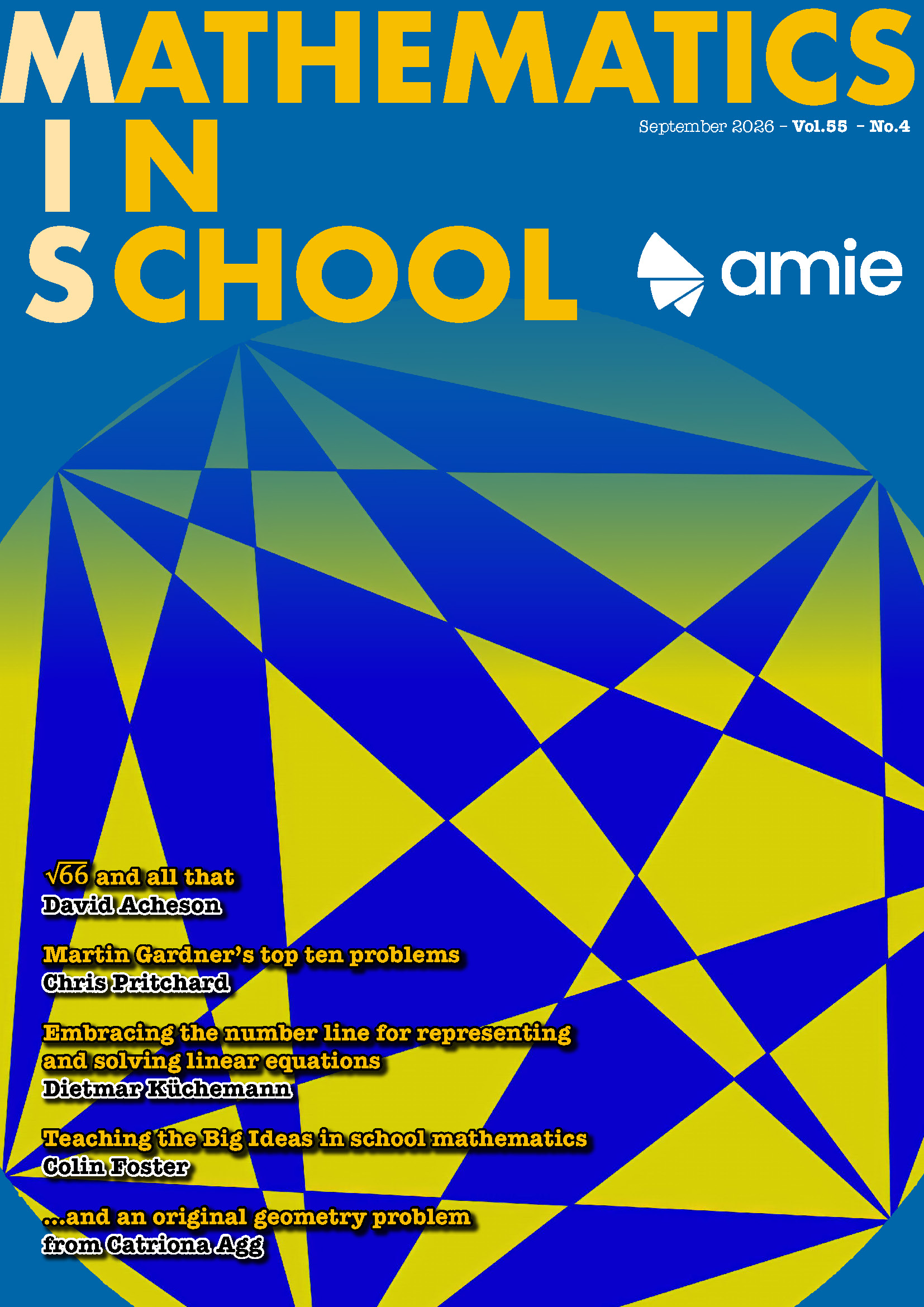
Mathematics in School
Mathematics in School is a lively and resource packed A4 Secondary Education journal published by The Mathematical Association that is aimed at teachers of secondary pupils, students in training and all those with a professional interest in mathematics education. As a long established designer journal it is unique among its peers ... contents include contributions from mathematics practitioners at all levels and articles that reflect the best of current thinking and practice by means of exploring further development and sharing practical experiences. Readers will find helpful advice on general teaching methods and each issue guarantees numerous articles of relevance and a book/product reviews section. Importantly, the wealth of material found in every issue has photo copy rights, providing busy teachers with hands on classroom resources.
![]()
Subscription Rates 2013
Mathematics in School Vol 41 - ISSN: 03057259
Frequency: 5 times per year, January, March, May, September, November
Full Price: £80 - Click here to subscribe
For overseas subscribers the following postage rates apply
Airmail Europe: £9.00
Airmail Zone 1/2: £12.50
Additional information on ordering
For more information relating to membership please visit the
Join the MA pages.
![]()
MIS Index
Index of past Maths in Schools articles, features and reviews, compiled by Grant Macleod
![]()
MIS Featured Article
Mathematics in School, January 2005, Vol 34 No 1
Page 9: Are we making progress? Proof by Claire Baldwin
![]()
Editorial Committee
Editors | |
Reviews Editor | Grant Macleod |
Editor-in-Chief | |
Sub-Editor | Helen Morris |
Production Editor |
Advertising enquiries should be addressed to The Advertising Manager.
![]()
Recent Issues
2005 | |||||
2006 | |||||
2007 | |||||
2008 | |||||
2009 |
|
|
|
![]()
Guidelines for Authors
Mathematics in School is aimed mainly at teachers of school and college pupils of 10 to 18 years of age and for those working with students who are preparing to enter the teaching profession.
We attempt to attain a balance of articles reflecting this age and ability range and look for pragmatic articles; ready-to-use materials; discursive, possibly philosophical articles; speculative, reflective, and sometimes retrospective pieces. Newsworthy items have a place, but the average two-month lead time sometimes precludes this. However, book and equipment reviews have a very important role to play. There is also the opportunity to stimulate - and even amuse - otherwise hard-pressed and very busy teachers. If you can submit an original article (i.e. usually, one that has not been published elsewhere) that fits this brief, then the Editors will be very happy to consider it for publication. Few articles used are over 4 pages long when typeset. Half-page 'fillers' are always welcome. They can be odd hints and tips, items of news, letters, cartoons or photographs with one¬line captions. Please note that this is not a refereed journal, but a second opinion is usually sought. An article may be rejected, but a suggestion may be made as to where else it could be submitted. An Editor may suggest changes, but that in itself cannot guarantee eventual publication. Naturally an Editor may also cut or otherwise modify an article themselves, but the Author alway has the opportunity to see the result at the proof-reading stage. Prompt return of the corrected proof is essential.
Always include at the top of the article:
Title - If you have alternative titles in mind, include them, in particular, an amusing or clever title usually benefits from a more descriptive subtitle as well.
Author(s) names in full.
Spelling Mathematics in School uses British spelling, according to The Oxford English Dictionary.
Illustrations, Illustrations, or suggestions for illustrations, are always welcome as MiS needs to be visually, as well as professionally and academically, stimulating. Preferably, Illustrations should be supplied in digital form. Photographs that have been scanned or taken from a digital camera should be saved to a TIFF file: colour images should be saved in CMYK format; mono images should be saved as greyscale. The resolution of both colour and mono images should be roughly 300 dpi. Line drawing scans should be saved in bitmap format at roughly 1000 dpi. File size should not exceed 15 MB. If you are not able to supply digital files any hard copy artwork needs to be clear and of the best quality.
References in the body of the text are given as: (Field, 2004).
At the end of the article:
Full References: Field, R. 2004 Geometric Patterns from Islamic Art and Architecture, Tarquin Publications, Norfolk. Jagger, J. 2005 'A Comment on the Teaching of Simultaneous Equation'’, Mathematics in School, 34, 1.
Keywords: Please supply up to three keywords, at the end of your article, to assist with indexing and searching.
Correspondence: Please supply a postal address of your current institution and an e-mail address by which you can be contacted. A personal address can be provided but note this will not appear on the article.